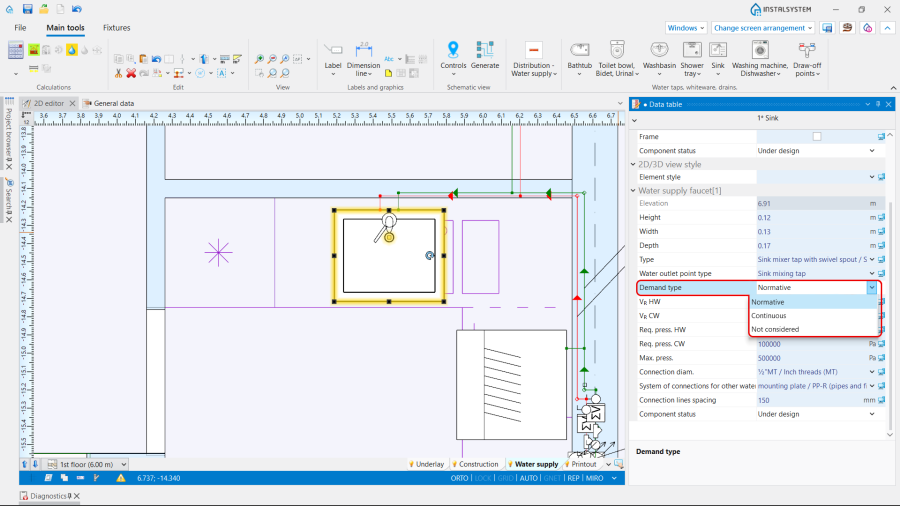
Note!消防栓 outflows ARE NOT taken into account in the calculation of 连续的 demand, but ARE taken for the calculation of simultaneous flow. Number of hydrants for the particular pipe-run is determined in accordance with the data set in the 一般参数 window:
2. 计算标准和选项.
不计入
If the option 不计入 is set, it means that this 用水器具 is not taken into account in the calculations. In this case, the outflow in the pipe-runs is calculated as follows:
For the pipe-runs feed directly the 用水器具 and in series with several 用水器具:
VS=VR, [dm3/s], where:
VS - 体积流量 in the pipe-run,
VR - 额定流量 of 用水器具;
If ONLY 用水器具 that are 不计入 are located at the end of the branch of the installation (coming from the 水源), then the outflow in the pipe-run collecting the pipes connected to these appliances is determined as the maximum (V of pipe-runs from the 用水器具);
If a pipe-run feeding 不计入用水器具 is connected to a pipe-run feeds (directly or indirectly through other pipe-runs) 用水器具 with 标准的 (variable) / 连续的 demand / 消防栓, the outflow in such a pipe-run is calculated as the simultaneous and DOES NOT TAKE INTO ACCOUNT the 标准的 demands from 不计入用水器具;
For the pipe-runs connected indirectly in addition to 不计入用水器具, at least to two 用水器具 with 标准的 (variable) demand, the outflow is determined in accordance with the relevant standard method for Normative outflow.
Note!不计入用水器具 are included in the hydraulic 计算 in the same way as other 用水器具:
The program determines pressure losses in pipe-runs connected (directly or indirectly) to the 不计入用水器具 based on the outflow values in these pipe-runs (and displays them as hints and in the 结果 tables);
不计入用水器具 can become a critical receiver (occur Critical hydraulic route – a route with the greatest pressure losses).