給水用水点的需求类型:修订间差异
跳转到导航
跳转到搜索
无编辑摘要 |
无编辑摘要 |
||
| 第31行: | 第31行: | ||
#* ''V<sub>可变</sub> = V<sub>R</sub> [<IS_TS id=_rssDecymetrDo3NaSekunde/>]'' ,在此; | #* ''V<sub>可变</sub> = V<sub>R</sub> [<IS_TS id=_rssDecymetrDo3NaSekunde/>]'' ,在此; | ||
#** '' V<sub>R</sub> - ''<IS_TS id=iNameSanOdbiornikOgolny/>''的<IS_TS id=WydatekNormatywny/>'' ; | #** '' V<sub>R</sub> - ''<IS_TS id=iNameSanOdbiornikOgolny/>''的<IS_TS id=WydatekNormatywny/>'' ; | ||
# 在连接至需求类型可变的''多个<IS_TS id=iNameSanOdbiornikOgolny/> 的管道系统中 - | # 在连接至需求类型可变的''多个<IS_TS id=iNameSanOdbiornikOgolny/> 的管道系统中 - 基于所有标准通用的计算公式: | ||
#* ''V<sub>可变</sub> = a * (<IS_TS id=SumaWypNormShort/>) ^ b + c, [<IS_TS id=_rssDecymetrDo3NaSekunde/>]'' ,在此: | #* ''V<sub>可变</sub> = a * (<IS_TS id=SumaWypNormShort/>) ^ b + c, [<IS_TS id=_rssDecymetrDo3NaSekunde/>]'' ,在此: | ||
#** ''a, b, c'' - 系数,基于给定的''<IS_TS id=norma_obliczeniowa/>''建筑类型取不同的数值, | #** ''a, b, c'' - 系数,基于给定的''<IS_TS id=norma_obliczeniowa/>'' 建筑类型取不同的数值, | ||
#** ''<IS_TS id=SumaWypNormShort/> - ''<IS_TS id=iNameSanOdbiornikOgolnyPlural/>'' 的<IS_TS id=SumaWypNorm/>''。 <br> | #** ''<IS_TS id=SumaWypNormShort/> - ''<IS_TS id=iNameSanOdbiornikOgolnyPlural/>'' 的<IS_TS id=SumaWypNorm/>''。 <br> | ||
'''注!''' 上述公式各组成部分的计算值,如系数(a、b、c)、''<IS_TS id=WydatekNormatywny/> (V<sub>R</sub>)'' 以及取决于''<IS_TS id=SumaWypNorm/> (<IS_TS id=SumaWypNormShort/>)'' | '''注!''' 上述公式各组成部分的计算值,如系数(a、b、c)、''<IS_TS id=WydatekNormatywny/> (V<sub>R</sub>)'' 以及取决于''<IS_TS id=SumaWypNorm/> (<IS_TS id=SumaWypNormShort/>)'' 的公式适用范围,由''<IS_TS id=rsDanogi/>'' 窗口中选择的''<IS_TS id=norma_obliczeniowa/>'' 强制执行。{{Info}} [[给水系统的设计#选择目录和定义一般参数|选择目录和定义一般参数]]。<br/><br/> | ||
===<IS_TS id=strpnOdbCiagly/>=== | ===<IS_TS id=strpnOdbCiagly/>=== | ||
2026年3月26日 (四) 05:02的版本
| 产品 | InstalSystem 5 |
| 文章类型 | 提示和技巧 |
| 版本的最新内容 | 2026-03-04 |
问题说明
在供水系统安装设计过程中,该程序提供三种选项用于确定供水龙头的需求类型 ,这些选项可在参数表 窗口中选择:
- 标准的,
- 连续的,
- 不计入.
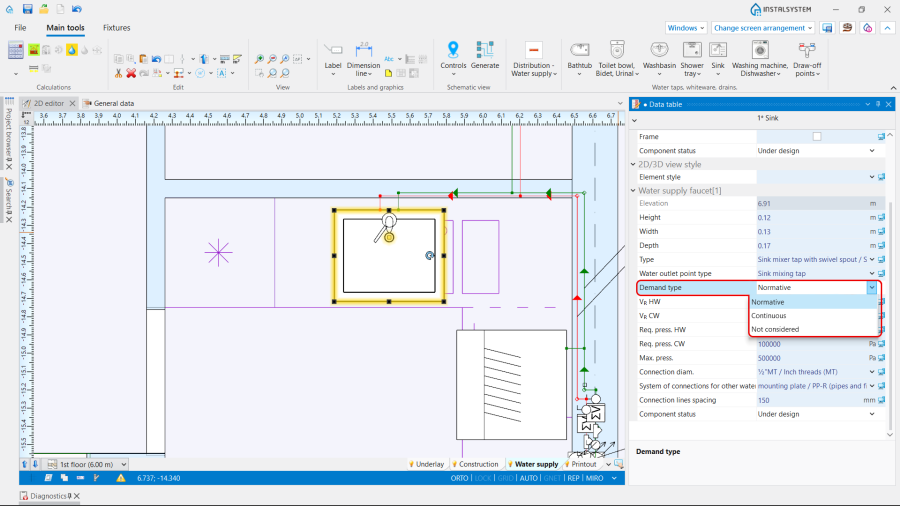
1. 需求类型.

这些选项直接影响给水系统计算 的性能。
解决方案
标准的
该方法用于对需求可变的水龙头的供水管道计算其水流量:
- 在直接或间接(例如一系列相连的管道)连接至需求类型可变的单个用水器具 的管道系统中(无论其位置如何):
- V可变 = VR [dm3/s] ,在此;
- VR - 用水器具的额定流量 ;
- V可变 = VR [dm3/s] ,在此;
- 在连接至需求类型可变的多个用水器具 的管道系统中 - 基于所有标准通用的计算公式:
- V可变 = a * (ΣVR) ^ b + c, [dm3/s] ,在此:
- a, b, c - 系数,基于给定的计算标准 建筑类型取不同的数值,
- ΣVR - 用水器具 的总额定流量。
- V可变 = a * (ΣVR) ^ b + c, [dm3/s] ,在此:
注! 上述公式各组成部分的计算值,如系数(a、b、c)、额定流量 (VR) 以及取决于总额定流量 (ΣVR) 的公式适用范围,由一般参数 窗口中选择的计算标准 强制执行。更多信息,见: 选择目录和定义一般参数。
连续的
该方法用于计算带有连续的 需求的用水点其給水管道的水流量:
- Vc = ΣVc, [dm3/s] ,在此;
- Vc - 连续的 outflow of 用水器具.
Note! 消防栓 outflows ARE NOT taken into account in the calculation of 连续的 demand, but ARE taken for the calculation of simultaneous flow. Number of hydrants for the particular pipe-run is determined in accordance with the data set in the 一般参数 window:

不计入
If the option 不计入 is set, it means that this 用水器具 is not taken into account in the calculations. In this case, the outflow in the pipe-runs is calculated as follows:
- For the pipe-runs feed directly the 用水器具 and in series with several 用水器具:
- VS=VR, [dm3/s], where:
- VS - 体积流量 in the pipe-run,
- VR - 额定流量 of 用水器具;
- VS=VR, [dm3/s], where:
- If ONLY 用水器具 that are 不计入 are located at the end of the branch of the installation (coming from the 水源), then the outflow in the pipe-run collecting the pipes connected to these appliances is determined as the maximum (V of pipe-runs from the 用水器具);
- If a pipe-run feeding 不计入 用水器具 is connected to a pipe-run feeds (directly or indirectly through other pipe-runs) 用水器具 with 标准的 (variable) / 连续的 demand / 消防栓, the outflow in such a pipe-run is calculated as the simultaneous and DOES NOT TAKE INTO ACCOUNT the 标准的 demands from 不计入 用水器具;
- For the pipe-runs connected indirectly in addition to 不计入 用水器具, at least to two 用水器具 with 标准的 (variable) demand, the outflow is determined in accordance with the relevant standard method for Normative outflow.
Note! 不计入 用水器具 are included in the hydraulic 计算 in the same way as other 用水器具:
- The program determines pressure losses in pipe-runs connected (directly or indirectly) to the 不计入 用水器具 based on the outflow values in these pipe-runs (and displays them as hints and in the 结果 tables);
- 不计入 用水器具 can become a critical receiver (occur Critical hydraulic route – a route with the greatest pressure losses).