建筑结构的准备 - 屋顶建模 - 天窗的创建:修订间差异
(→说明) |
(→说明) |
||
| 第19行: | 第19行: | ||
==说明== | ==说明== | ||
本文描述了''<IS_TS id=Lukarna/>'' | 本文描述了''<IS_TS id=Lukarna/>'' 建模的路径。它可以使用与创建''<IS_TS id=Roof/>'' 相关的工具去创建,也可以直接使用''<IS_TS id=Lukarna/>'' 进行创建。<br/> | ||
''<IS_TS id=Lukarna/>'' 只能插入到现有的''<IS_TS id=Roof/>'' 范围内,''<IS_TS id=Lukarna/>'' | ''<IS_TS id=Lukarna/>'' 只能插入到现有的''<IS_TS id=Roof/>'' 范围内,''<IS_TS id=Lukarna/>'' 不得伸出屋顶轮廓之外。如有必要,可以为此人为绘制/修改屋顶,或创建建筑的特定部分。<br/> | ||
在执行 ''<IS_TS id=BuildingStructureCalculation/>'' 后,''<IS_TS id=Lukarna/>'' | 在执行 ''<IS_TS id=BuildingStructureCalculation/>'' 后,''<IS_TS id=Lukarna/>'' 将会与自动生成的垂直围护结构一起生成,根据两个图元之间的位置,自动创建特定形状和尺寸的墙体。墙体从上方以老虎窗屋顶为界,下方以屋顶坡度为界。<br/> | ||
''<IS_TS id= | 在进行 ''<IS_TS id=BuildingStructureCalculation/>'' 后, ''<IS_TS id=Lukarna/>'' 将会插入到没有错误的现有屋顶上。<br/> | ||
默认的''<IS_TS id=Lukarna/>'' 将以平面老虎窗插入 - 程序会设置最大坐标(从屋顶平面上的特定点开始),使其默认为水平老虎窗。<br/> | |||
默认的''<IS_TS id=Lukarna/>'' | 在进行建筑结构计算后,将Dormer插入到没有错误的现有屋顶上。<br/> | ||
该程序考虑了所插入的''<IS_TS id=Lukarna/>'' 的房间的立方容量。<br/> | |||
所附项目为''<IS_TS id=Lukarna/>'' 创建的最常见情况提供了解决方案。<br/> | |||
==Location in the program== | ==Location in the program== | ||
2025年3月25日 (二) 04:52的版本
| 产品 | InstalSystem 5 |
| 文章类型 | 功能和工具 |
| 版本的最新内容 | 2024-11-19 |
说明
本文描述了天窗 建模的路径。它可以使用与创建屋顶 相关的工具去创建,也可以直接使用天窗 进行创建。
天窗 只能插入到现有的屋顶 范围内,天窗 不得伸出屋顶轮廓之外。如有必要,可以为此人为绘制/修改屋顶,或创建建筑的特定部分。
在执行 建筑结构计算 后,天窗 将会与自动生成的垂直围护结构一起生成,根据两个图元之间的位置,自动创建特定形状和尺寸的墙体。墙体从上方以老虎窗屋顶为界,下方以屋顶坡度为界。
在进行 建筑结构计算 后, 天窗 将会插入到没有错误的现有屋顶上。
默认的天窗 将以平面老虎窗插入 - 程序会设置最大坐标(从屋顶平面上的特定点开始),使其默认为水平老虎窗。
在进行建筑结构计算后,将Dormer插入到没有错误的现有屋顶上。
该程序考虑了所插入的天窗 的房间的立方容量。
所附项目为天窗 创建的最常见情况提供了解决方案。
Location in the program
- Icons of components and of functions for 屋顶 modeling are available in the 2D编辑器 window on the 主工具 bar, section 建筑, 屋顶 tab, when 建筑 editing is enabled.
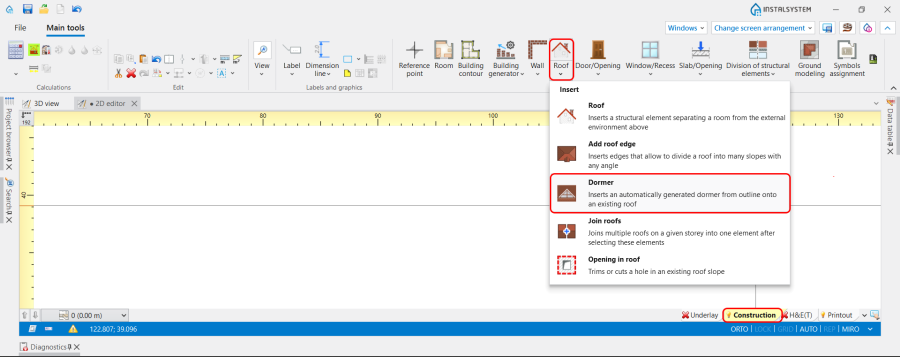
1. 天窗 location.

Example of use
Roof-operated 天窗
天窗 is modelled as part of the 屋顶. Created with the 添加屋顶边缘 function. 更多信息,见: Add roof edge.
For multi-storey 屋顶 it is required to use also the function 修剪楼板(由屋顶部件).更多信息,见: Trim slab by roof element.
Note: Particular attention must be paid to the correct modelling of knee walls.
Sample project: Roof-operated Dormer, isproj
天窗 flush with the front wall
Modelling of 天窗 flush with the front wall is a common solution:
- Insert 天窗;
- Use the 添加屋顶边缘 function to insert edges if necessary;
- Specify the elevations or slopes;
- Insert 窗.
Sample project: Dormer flush with the front wall, isproj
天窗 extending beyond the outline of the building
- Use 墙 and 楼板 elements to create the part extending beyond the building contour; 更多信息,见: Inserting walls ,Inserting slabs.
- 屋顶 should be completely covered over the protruding part of the building;
- Insert 天窗 over the protruding part of the building. Steps to perform are: Dormer flush with the front wall.
Sample project: Dormer extending beyond the outline of the building, isproj
天窗 covering several rooms
Steps to perform are: Dormer flush with the front wall or Dormer extending beyond the outline of the building.
Sample project: Dormer covering several rooms, isproj

If a 天窗 covers several rooms and there are other physical walls between the dormer's outermost side walls - these are cut not through the roof proper but through the dormer's roof.
Multi-storey 天窗 extending beyond the outline of the building
Steps to perform are: Dormer extending beyond the outline of the building.
Note: In this case multi-storey 房间 should be used. 更多信息,见: Multi-storey rooms.
Sample project: Multi storey Dormer extending beyond the outline of the building, isproj

Dormer covers multi-storey rooms.
天窗 located below the storey on which the 屋顶 is inserted (multi-storey 屋顶)
天窗 may be located below the storey on which the roof is inserted. Such 天窗 should be placed on the storey on which the roof is located, even though the dormer is located on a lower storey.
Note: To create storeys of different levels in the same building, use additional storey levels. 更多信息,见: Create additional and internal storey levels.
Can be created like Roof operated Dormer or Dormer flush with the front wall.

Dormer located below the storey on which the Roof is inserted, isproj
天窗 located in a building with 附加楼层
The principle of creating such 天窗 is identical to the other cases. 天窗 can be placed either on the 屋顶 of the main storey or on the 屋顶 part defined by the 附加楼层 above.
Sample project: Dormer located in a building with Additional storey level, isproj

Additional information
- 天窗 has a smaller label than the 屋顶 element, it is distinguished on the 2D plan by dashed red lines and a darker shade of red.
- 天窗 wall has a main longitudinal edge marking (hotpoints at the corners) and always faces the outside of the building - the thickness of the automatically generated dormer walls can only be changed from the inside of the rooms. It is recommended that the thickness of these walls is consistent with the value of the internal vertical walls on which it is based.
- 天窗 relieves the requirement to cut an opening in the roof at the place of its insertion.
- Partitions such as windows, doors or wall openings can be inserted on the dormer walls.
- The user has the option to impose his own value - the thickness for the dormer roof.