辐射系统供水温度最佳化:修订间差异
跳转到导航
跳转到搜索
| 第25行: | 第25行: | ||
对于所选择的控制回路,可以在''<IS_TS id=btProjectOptions/>'' 窗口, 或在''<IS_TS id=ShowInteractiveCalculationWindow/>'' 窗口中对于所使用的''<IS_TS id=iNameCOZrodloPlural/>'' ,使用''<IS_TS id=Optimize/>'' 功能。 | 对于所选择的控制回路,可以在''<IS_TS id=btProjectOptions/>'' 窗口, 或在''<IS_TS id=ShowInteractiveCalculationWindow/>'' 窗口中对于所使用的''<IS_TS id=iNameCOZrodloPlural/>'' ,使用''<IS_TS id=Optimize/>'' 功能。 | ||
[[File:最佳化供水温度设置.png|900 px|left|thumb|1.在''<IS_TS id=btProjectOptions/>'' 窗口中的供水温度最佳化]]<br clear="all"/> | [[File:最佳化供水温度设置.png|900 px|left|thumb|1.在''<IS_TS id=btProjectOptions/>'' 窗口中的供水温度最佳化]]<br clear="all"/> | ||
[[File: | [[File:交互式最佳化供水温度设置.png|900 px|left|thumb|2.在''<IS_TS id=ShowInteractiveCalculationWindow/>'' 窗口中的供水温度最佳化]]<br clear="all"/> | ||
==应用举例== | ==应用举例== | ||
2025年11月24日 (一) 15:05的版本
| 产品 | InstalSystem 5 |
| 文章类型 | 功能和工具 |
| 版本的最新内容 | 2025-08-28 |
说明
该程序具有一个可以确定辐射供热系统最佳供水温度的独特功能。供水温度最佳化过程中使用了考虑多个参数及其权重的专有算法。 最佳化标准可以从以下选项中选择: 热输出和压降 或最小投资成本。在计算过程中,评估了数百个系统参数的配置选项,以实现所需的热输出。
在程序中的位置
对于所选择的控制回路,可以在一般参数 窗口, 或在交互式辐射系统计算 窗口中对于所使用的源 ,使用最佳化 功能。


应用举例
最佳化标准
用户可以从以下变量中选择优化标准:
- 热输出和压降 - 程序试图选择这样一个供水温度,以确保每个供热/供冷表面的热输出尽可能接近所需的温度,同时满足过热/欠热的公差范围,并保持尽可能低的压力损失。
- 最小投资成本 - 程序试图选择这样一个供水温度,以确保每个供热/供冷表面的热输出尽可能接近所需的温度,同时最大限度地降低投资成本(实际上意味着更高的供水温度)。
确定供水温度的标准
开始计算后,程序基于所选标准,根据以下规则,确定指示控制回路的最佳供水温度:
- The supply temperature is selected from the <min,max> range specified in the heat source data. The calculations are performed with high precision using a temperature increment of 0.1 K. For each intermediate value of the supply temperature, complete calculations of the radiant heating installation are performed, where the variables are: pipe spacing, number of loops and temperature drop of the medium in the loop. First, the preferred spacing configurations are those for which, according to the settings in the Advanced Settings tab, the heating outputs fall within the 'Matching' range. Second priority is given to those classified as 'Moderately Mismatched'. Finally, if no spacing configurations allow for achieving the required heating output (within the entire permissible supply temperature range) within the specified tolerance, the remaining spacing options are considered. In such cases, the heating outputs obtained from the selected or all surfaces may be significantly too high or too low.
- This process generates the so-called 'quality function', which is graphically represented as a polyline on 图形最佳化.
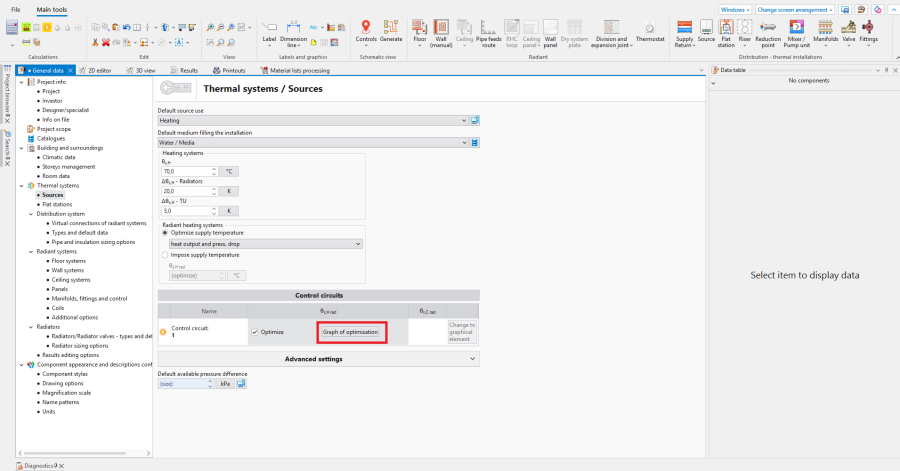
3. 控制回路.
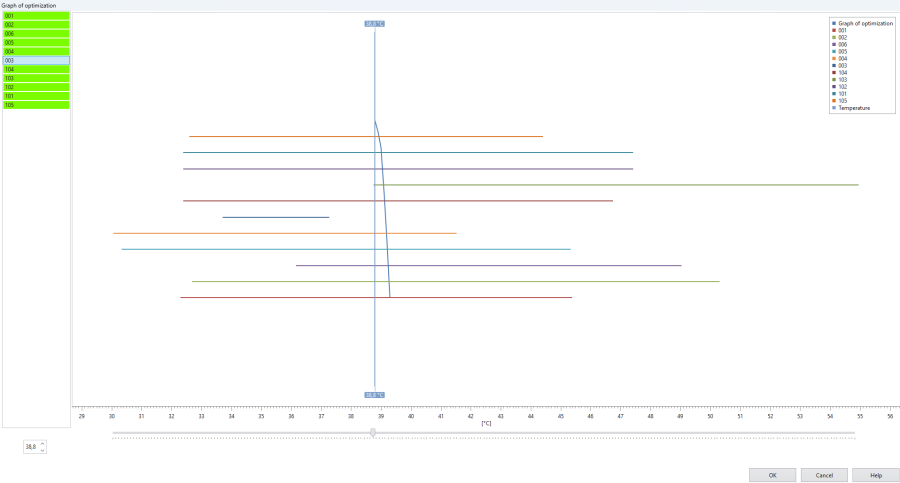
4. 图形最佳化. - Next, the point with the best value of the quality function is selected (the highest on the 图形最佳化).). In the case where multiple temperatures have the same maximum value of the quality function (within a certain tolerance), the program chooses the lowest of them.
- The shape of the quality function also depends on the selected variant of supply temperature optimization:
- For the 热输出和压降 criterion, the parameters mainly affecting user comfort are considered, i.e., the possibility of achieving a lower floor temperature, but also theoretically the possibility of changing the floor covering.
- For the 最小投资成本 criterion, in addition to the parameters influencing user comfort, investment costs are also taken into account. Hence, solutions that allow for larger pipe spacing and, for example, the use of a manifold with fewer circuits are preferred.
- It is possible to obtain an identical supply temperature value for both optimization criteria, but most often the program will then select different values of pipe spacing. This results from the fact that the quality function for temperature behaves differently for the two criteria, although its maximum may occur at the same point. However, for the same value under the 最小投资成本 criterion, the program will select a larger spacing in order to reduce the total pipe length.
- An error message may occur indicating that it is not possible to determine the supply temperature (e.g., if the required heating capacity is too high compared to the system’s capability). In such a case, the program adopts the maximum value defined for the given control circuit (source/mixing valve/mixing unit).

